 English
 русский
 Português
 عربى

A rotating equipment engineer at a steel finishing mill recently described a flexible coupling that had failed twice in...
READ MORE
LLA Type Tyre Coupling: Flexible, Reliable Power Transmission for Demanding Industrial Systems
Admin 2026-10-13Content
- 1 1. Operating Principle of the LLA Type Tyre Coupling
- 2 2. Main Construction and Component Functions
- 3 3. Elastic Compensation of Shaft Misalignment
- 4 4. Vibration Absorption and Shock Protection
- 5 5. Advantages Compared with More Rigid or Less Maintainable Couplings
- 6 6. Materials and Manufacturing Technology
- 7 7. Engineering Selection Considerations
- 8 8. Installation Best Practices
- 9 9. Maintenance and Replacement of the Tyre Element
- 10 10. Applications Across Industrial Sectors
- 11 11. Manufacturing and Service Strengths
- 12 12. Quality Management from Design to Delivery
- 13 13. Storage and Service Life Considerations
- 14 14. Safety Considerations
- 15 15. Frequently Asked Questions
- 15.1 Q1: What is an LLA type tyre coupling?
- 15.2 Q2: What are the main components of the coupling?
- 15.3 Q3: Why is the open tyre structure useful?
- 15.4 Q4: Can the coupling compensate for all shaft alignment errors?
- 15.5 Q5: Which tyre material should be selected?
- 15.6 Q6: Is the coupling suitable for reversing operation?
- 15.7 Q7: Can the coupling be used in crane and hoisting systems?
- 15.8 Q8: How can a protective cover improve service performance?
- 15.9 Q9: What signs indicate that the tyre should be replaced?
- 15.10 Q10: Can non-standard couplings be produced?
- 15.11 Q11: What information is needed for coupling selection?
- 15.12 Q12: How does the coupling protect connected equipment?
- 16 16. Conclusion
- 17 References
- 18 Product: LLA Type Tyre Coupling
Industrial transmission systems operate under conditions that are rarely ideal. Motors, reducers, pumps, conveyors, cranes, hoists, crushers, rolling equipment, and processing machines may be exposed to dust, moisture, vibration, impact, repeated starting, and frequent changes in rotational direction. At the same time, shafts that appear correctly aligned during installation can develop axial, radial, or angular misalignment because of foundation movement, thermal expansion, shaft deformation, bearing wear, or changing operating loads.
These conditions place demanding requirements on a coupling. A rigid connection can transmit torque efficiently, but it cannot absorb shock or compensate for misalignment. A highly rigid metallic coupling may transfer damaging vibration directly into the motor and gearbox. A basic flexible coupling may provide limited protection but lack the load capacity, service life, or maintainability required by heavy industrial equipment. The LLA type tyre coupling is designed to address these combined requirements through a resilient tyre element, a practical open structure, and a high level of elastic displacement compensation.
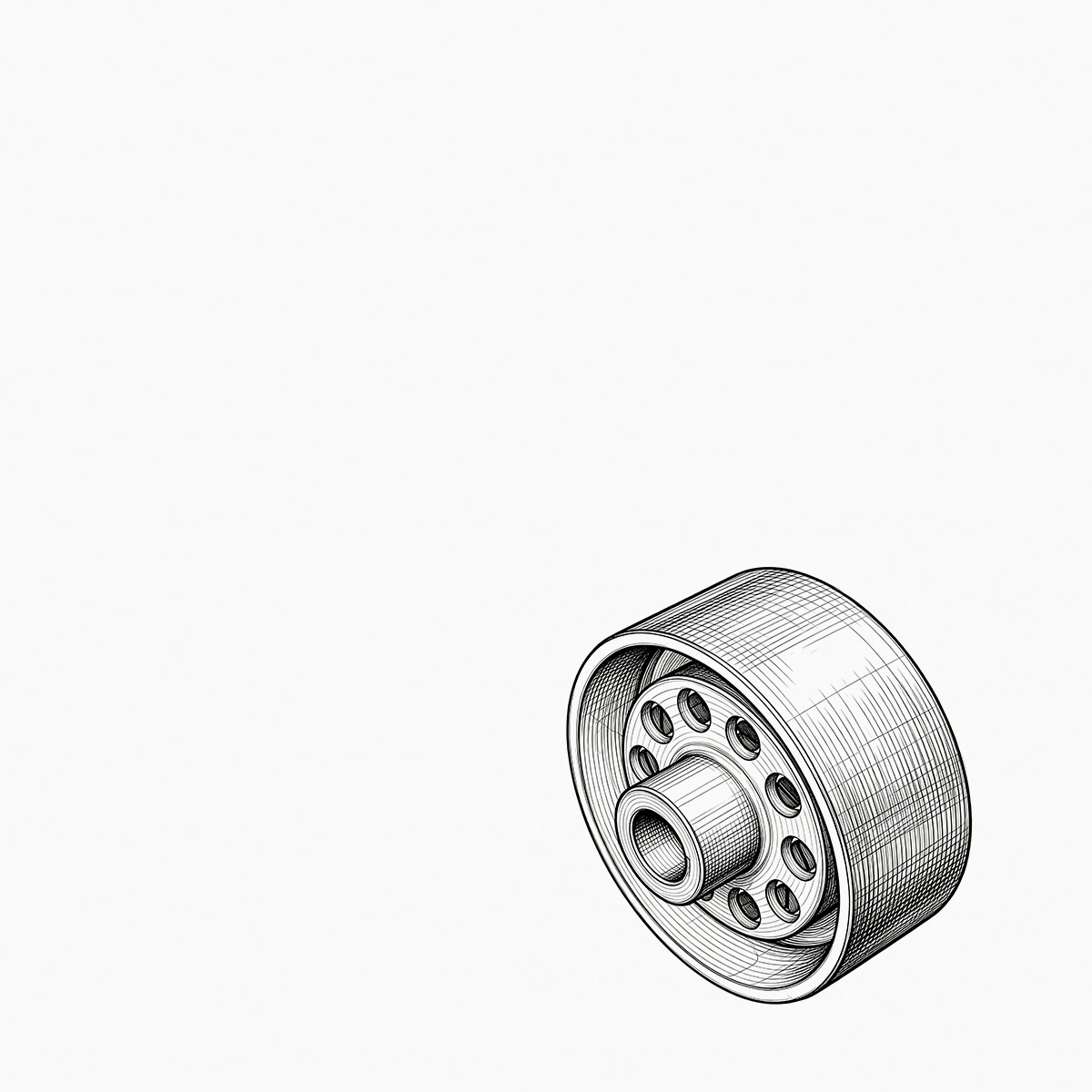
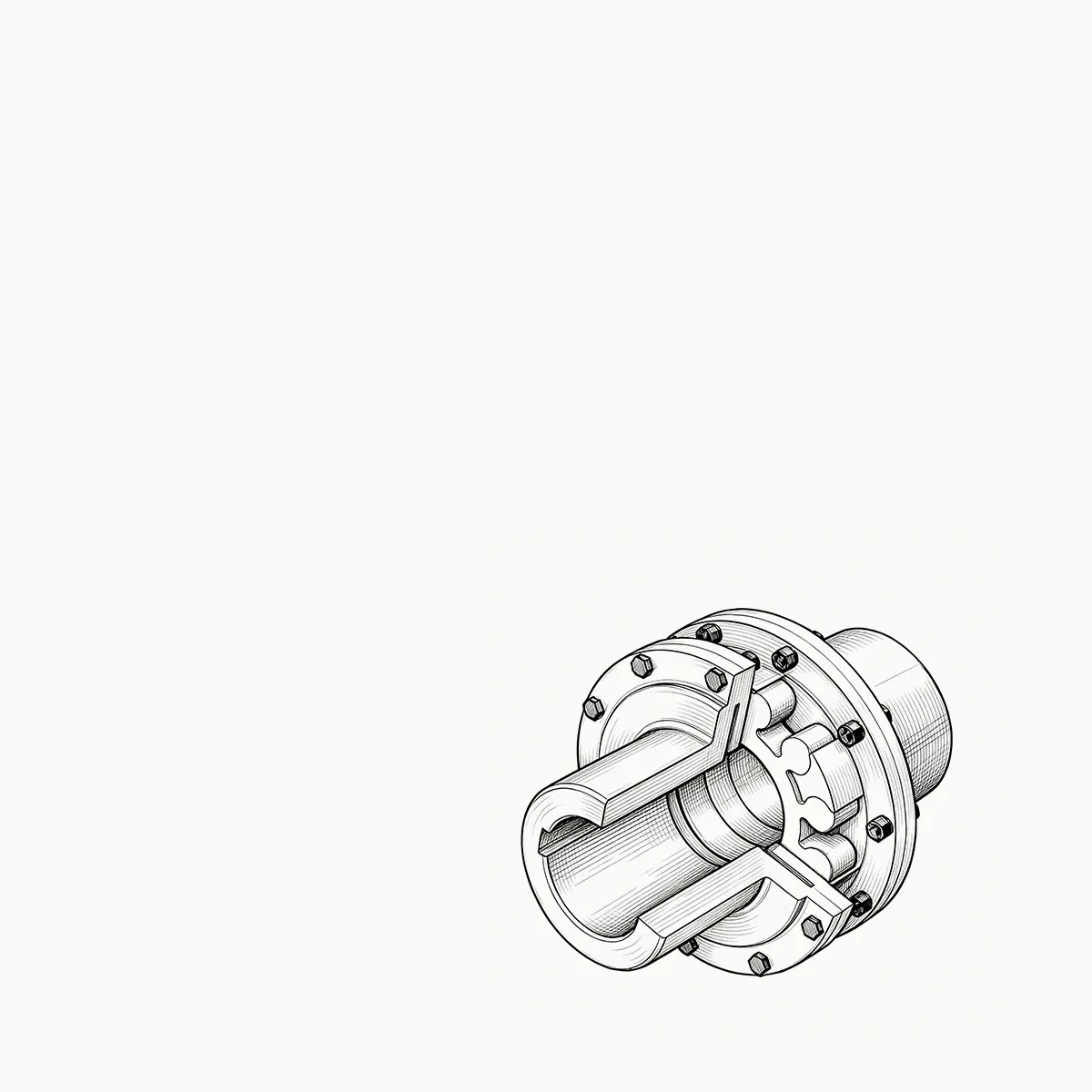
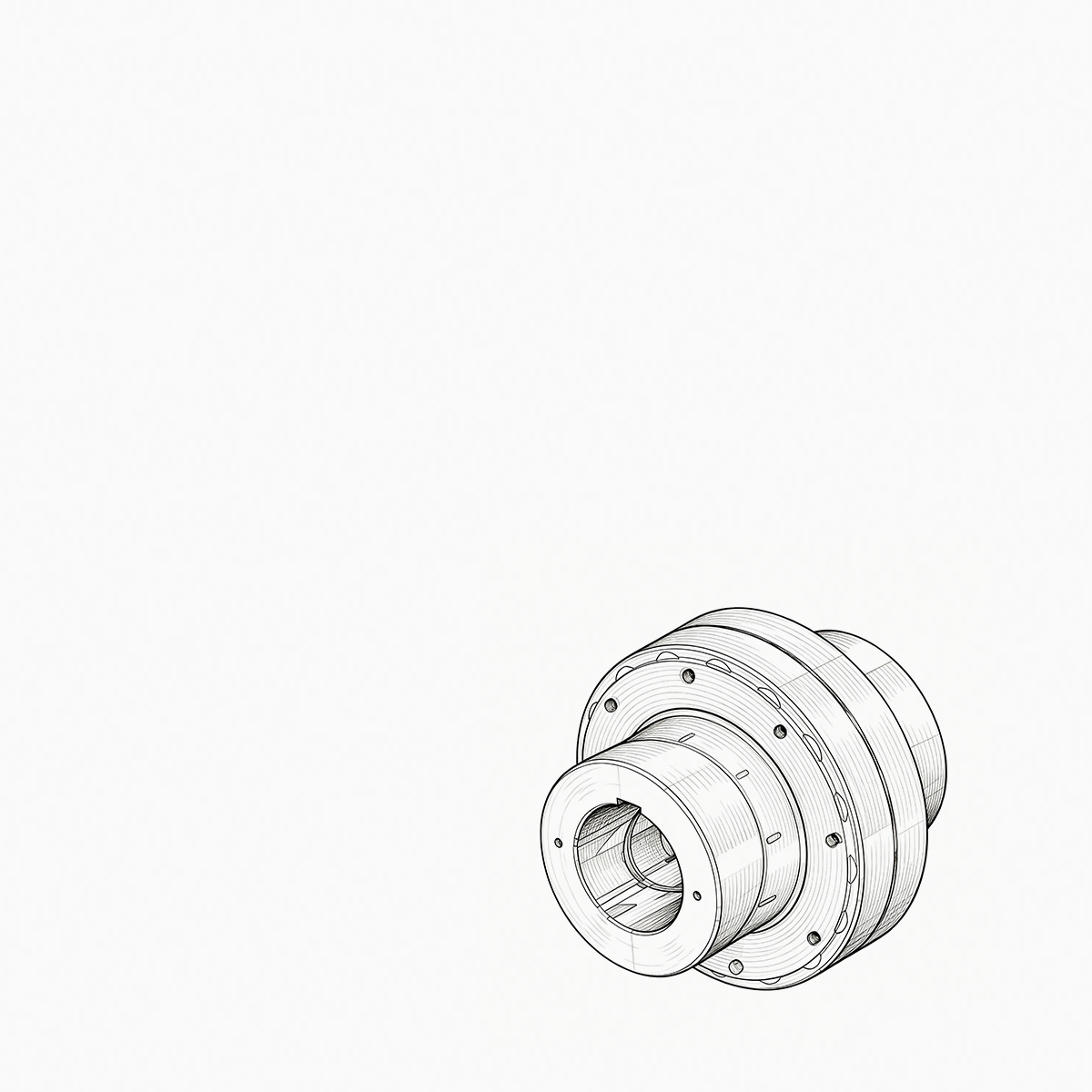
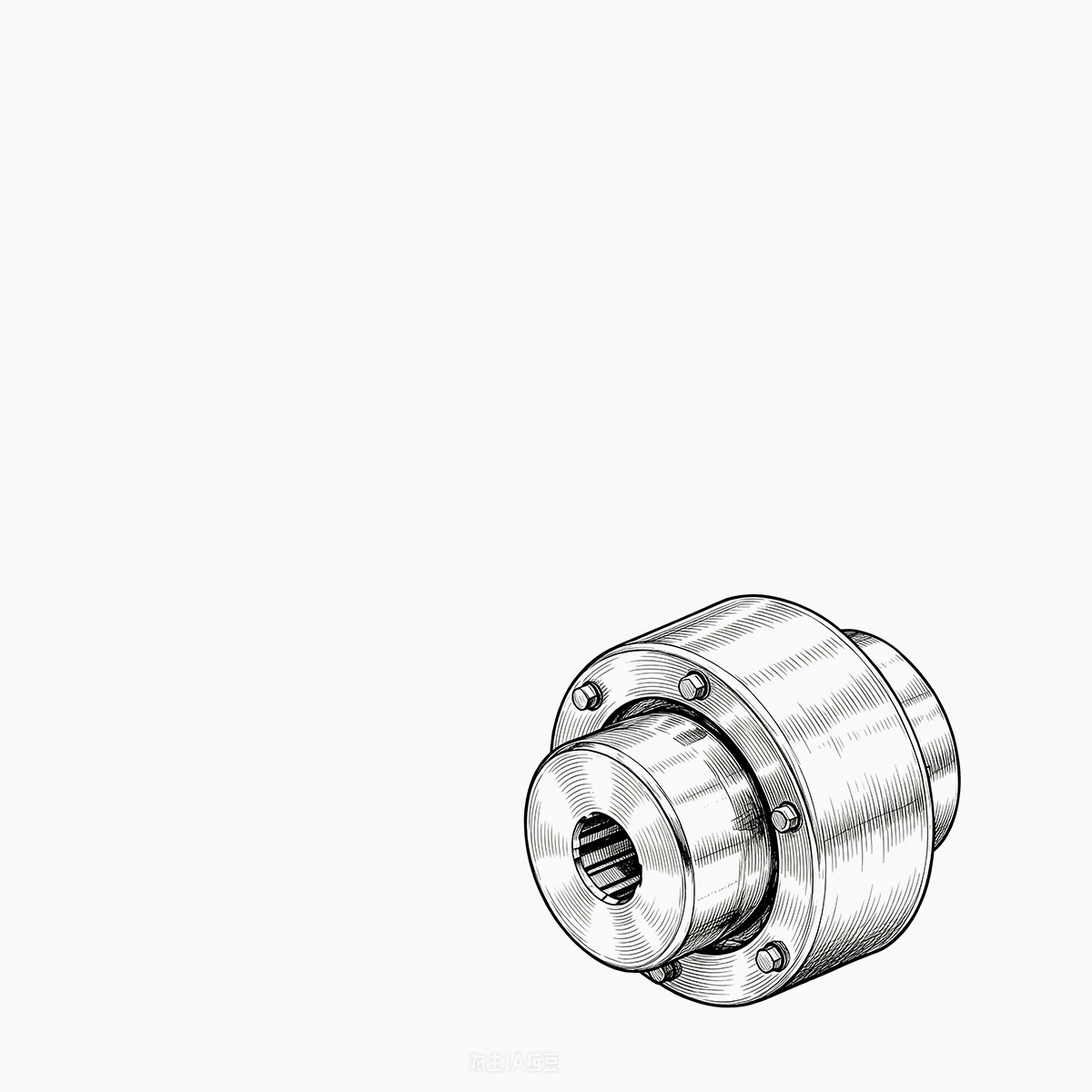
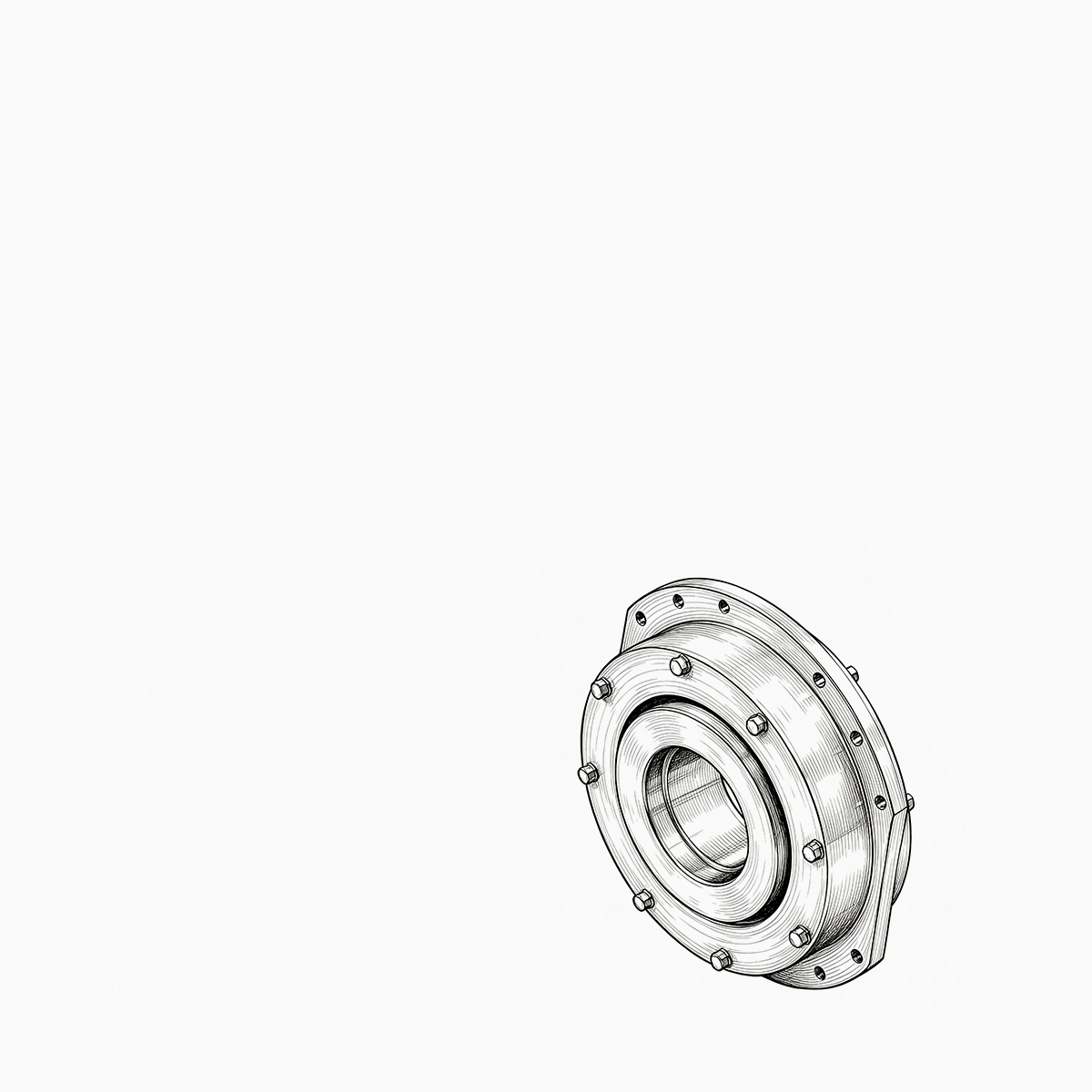
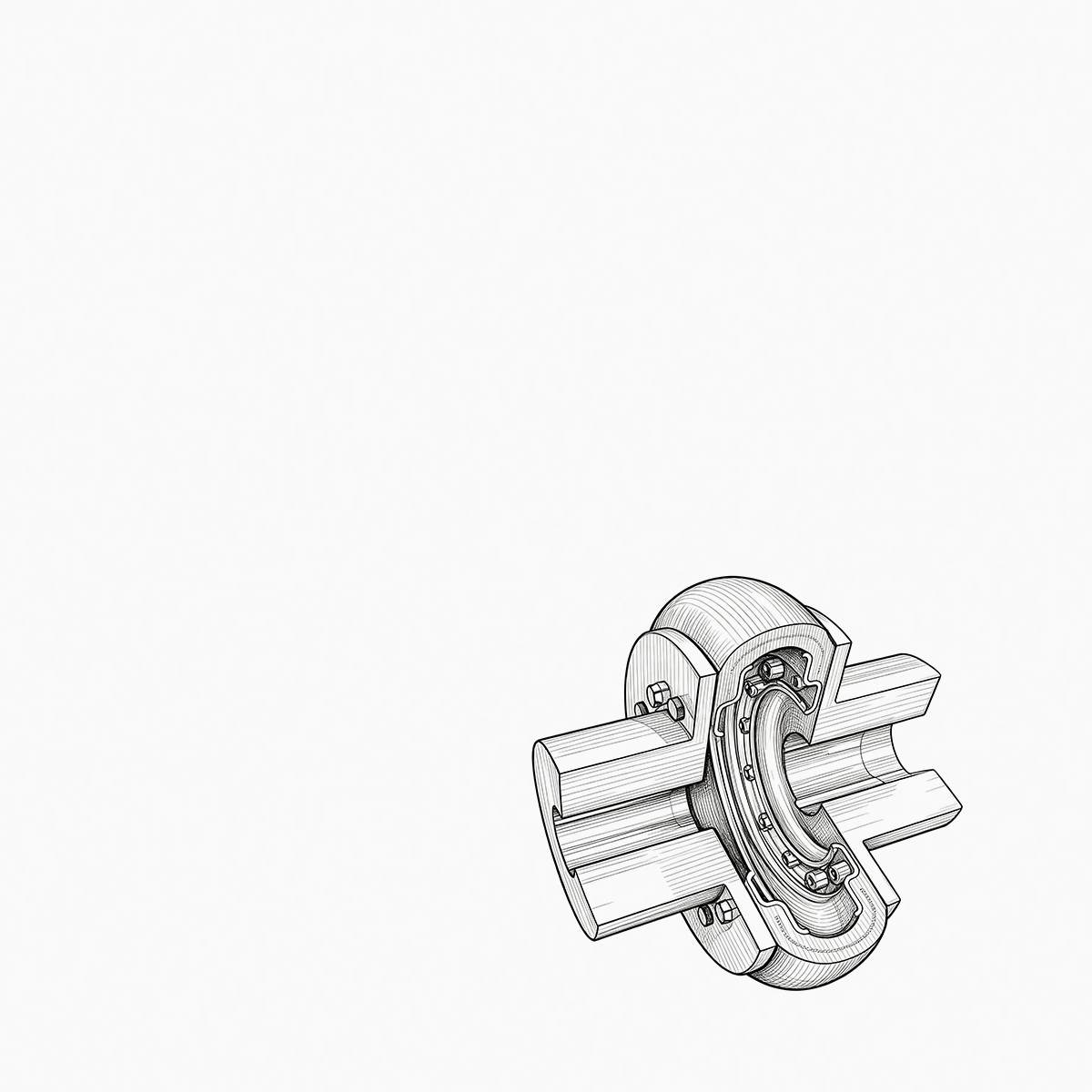
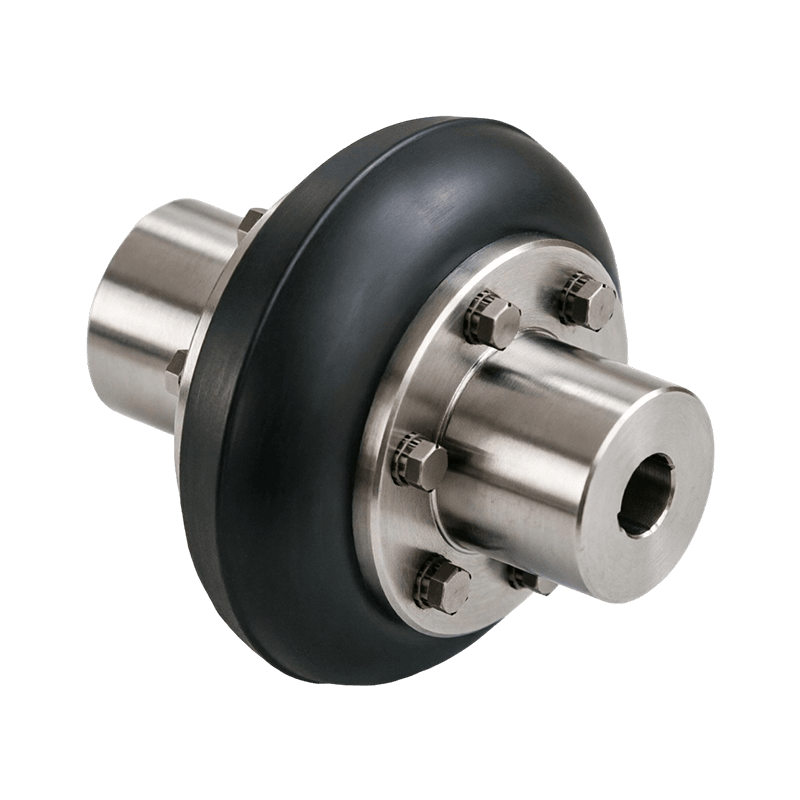
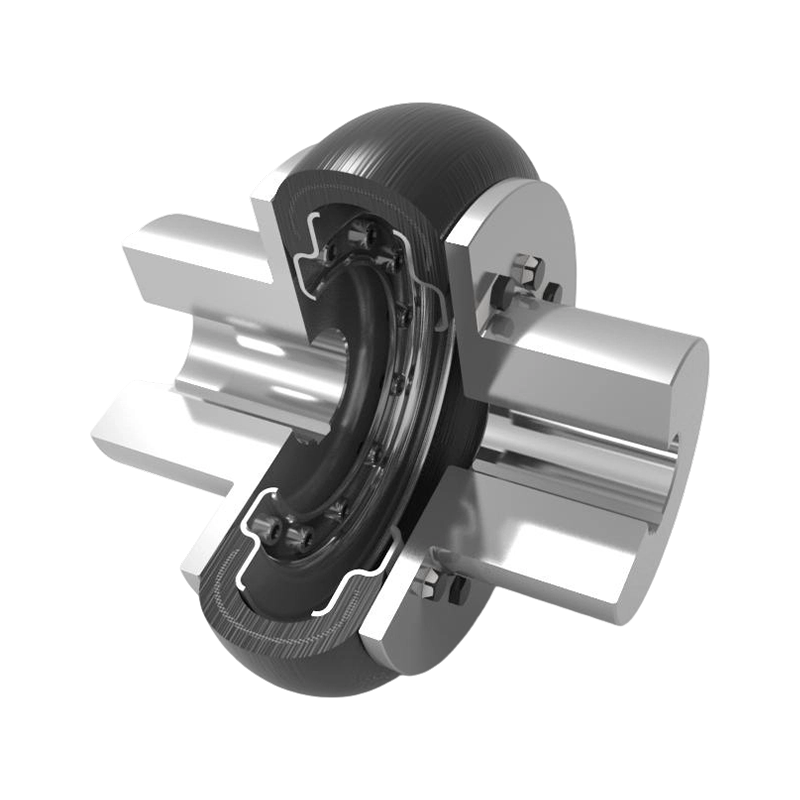
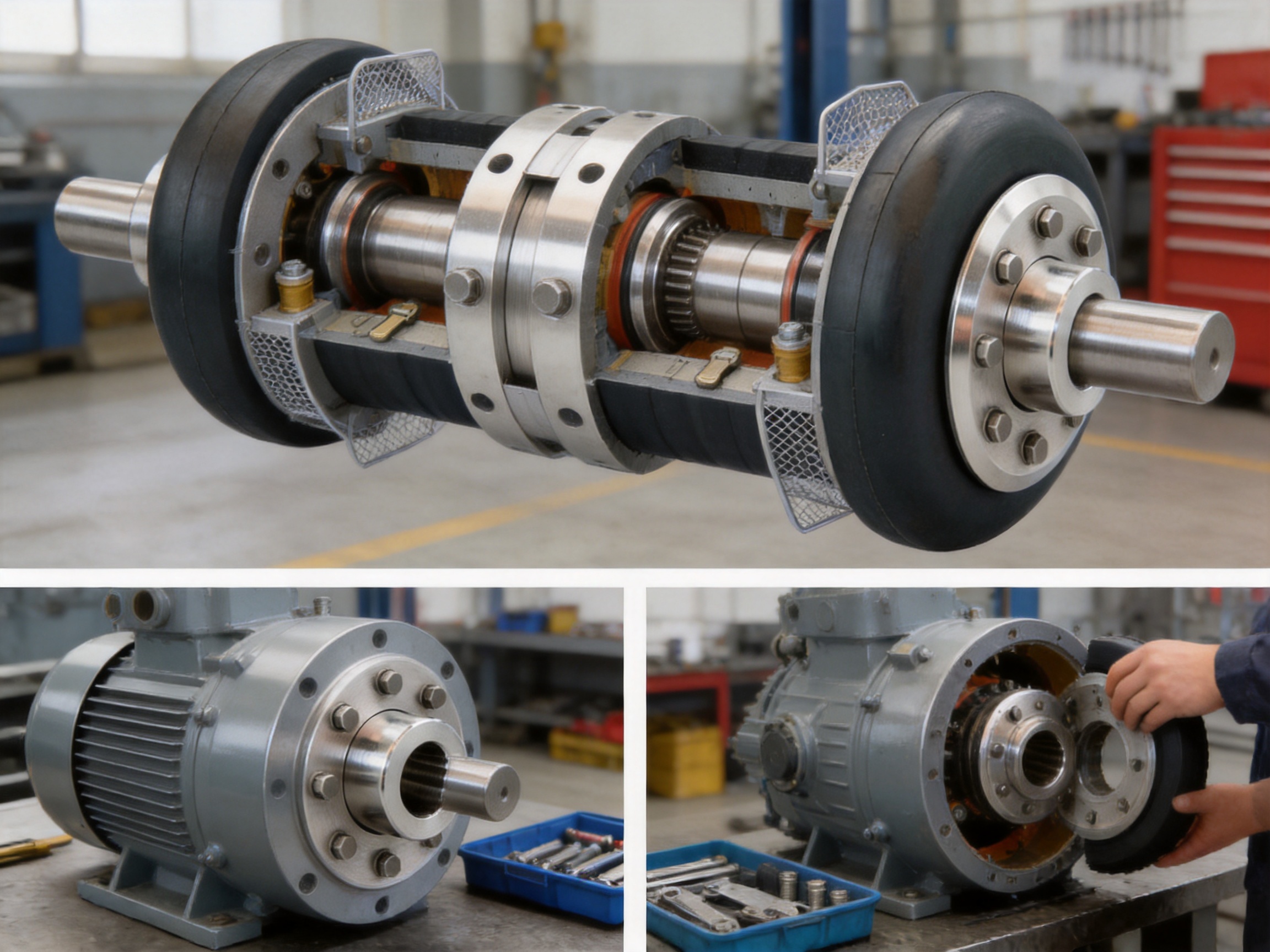
The LLA type tyre coupling is an industrial flexible coupling used to connect two shafts while transmitting torque and reducing the harmful effects of vibration, shock, and alignment errors. Its principal components include an elastic tyre body, metal pressure plates, coupling flanges, and fastening bolts. Depending on the application, a protective cover may also be provided. The tyre body is manufactured from high-strength rubber or polyurethane, with some designs incorporating nylon cord or nylon fabric reinforcement to improve load-bearing capability and dimensional stability.
One of the most important characteristics of the LLA design is its open tyre structure. Instead of permanently enclosing the elastic element inside a complicated housing, the tyre is clamped between metal pressure plates and connected to the coupling halves. This arrangement allows technicians to replace the elastic element by loosening the pressure plate bolts, without completely dismantling the connected motor, reducer, or driven machine. For equipment installed in difficult locations, this maintenance advantage can significantly reduce downtime and labor requirements.
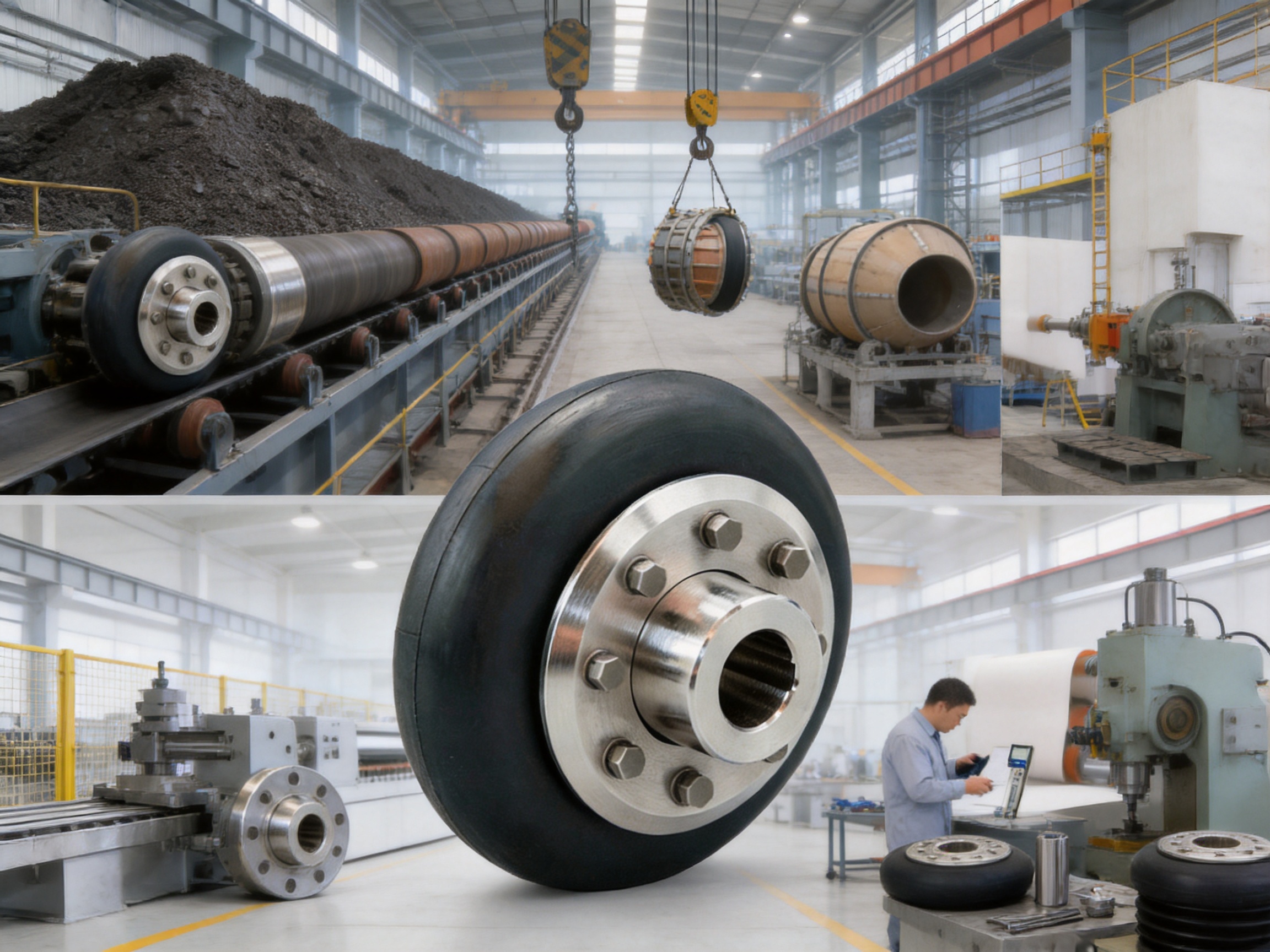
The combination of elastic performance, practical maintenance, and robust construction makes the LLA type tyre coupling suitable for many industrial applications. It can be used in transportation systems, metallurgy, mining, construction machinery, lifting equipment, paper machinery, and other drive systems where reliable torque transmission and effective vibration isolation are essential.
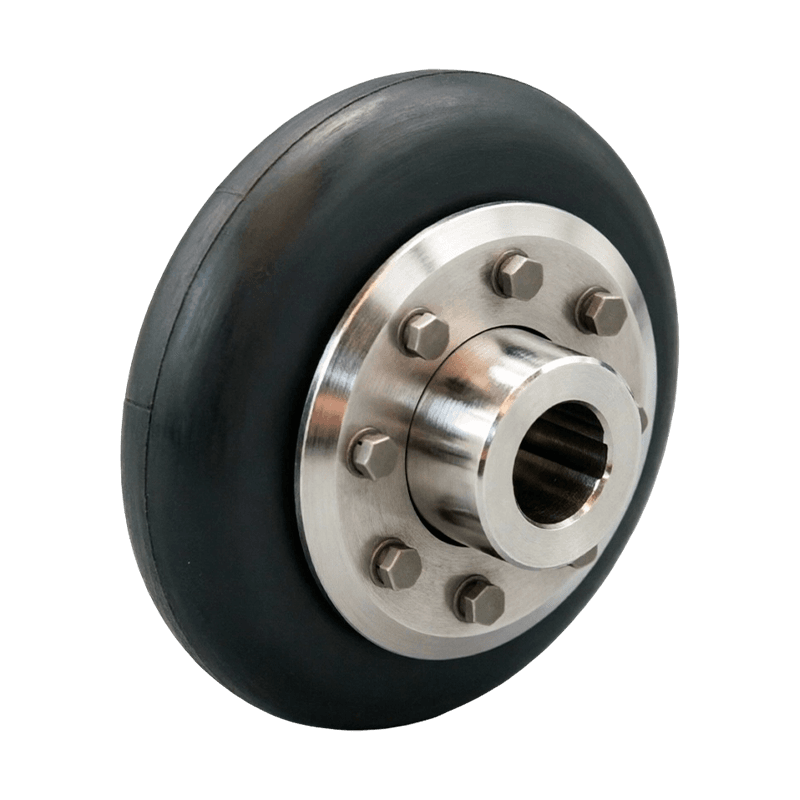
LLA Type Tyre Coupling
1. Operating Principle of the LLA Type Tyre Coupling
A coupling is installed between a driving shaft and a driven shaft. The driving shaft may belong to an electric motor, hydraulic motor, turbine, or other power source, while the driven shaft may be connected to a gearbox, conveyor, drum, pump, fan, mixer, crusher, or lifting mechanism. The coupling must transmit rotational torque while allowing a controlled degree of relative movement between the two shafts.
In the LLA type tyre coupling, torque is transferred through the metal coupling halves and the elastic tyre body. When the driving half rotates, the connecting components apply circumferential force to the tyre. The tyre then transmits this force to the opposite coupling half and the driven shaft. Because the tyre is made from an elastic material, it deforms slightly under load rather than behaving as a completely rigid mechanical link.
This controlled deformation provides several important functions. First, it absorbs a portion of the impact energy generated when a machine starts, stops, reverses, or experiences a sudden load change. Second, it reduces the transmission of torsional vibration from one machine to the other. Third, it allows the connected shafts to operate with limited axial, radial, and angular displacement. Finally, it helps reduce noise and mechanical wear throughout the drive system.
The tyre body is held by metal pressure plates and fastening bolts. The pressure plates distribute the clamping force over the tyre and secure it to the coupling flanges. The flange and pressure plate arrangement must be manufactured and assembled accurately so that the tyre is evenly supported and the transmitted load is distributed as uniformly as possible.
The design is particularly useful in applications where the shaft alignment cannot remain perfect throughout the entire operating cycle. For example, a long conveyor drive may experience foundation settlement or structural movement. A crane or hoist may experience changing loads and repeated starts. A paper machine may experience thermal changes and continuous operating vibration. The elastic tyre allows the coupling to accommodate these changes without imposing excessive additional forces on bearings and shafts.
2. Main Construction and Component Functions
2.1 Elastic Tyre Body
The elastic tyre is the central working element of the coupling. It is responsible for absorbing shock, isolating vibration, and accommodating shaft displacement. Depending on the required mechanical performance, the tyre may be made from high-strength rubber or polyurethane. Material selection depends on torque, rotational speed, temperature, environmental exposure, expected displacement, and duty cycle.
Rubber provides useful elasticity and damping characteristics. It can absorb vibration and reduce the transmission of impact energy, making it suitable for equipment with frequent starts, stops, and load changes. Polyurethane can provide a combination of elasticity, abrasion resistance, mechanical strength, and dimensional stability. The appropriate compound should be selected according to the actual service environment rather than by material name alone.
Some tyre bodies use internal nylon cord or nylon fabric reinforcement. This reinforcement supports the elastic material under repeated load and helps control deformation. It can improve the tyre’s ability to withstand cyclic stress and maintain its shape during operation. The reinforcement is embedded into the tyre during manufacturing and is firmly bonded to the surrounding material through a controlled vulcanization process.
2.2 Metal Pressure Plates
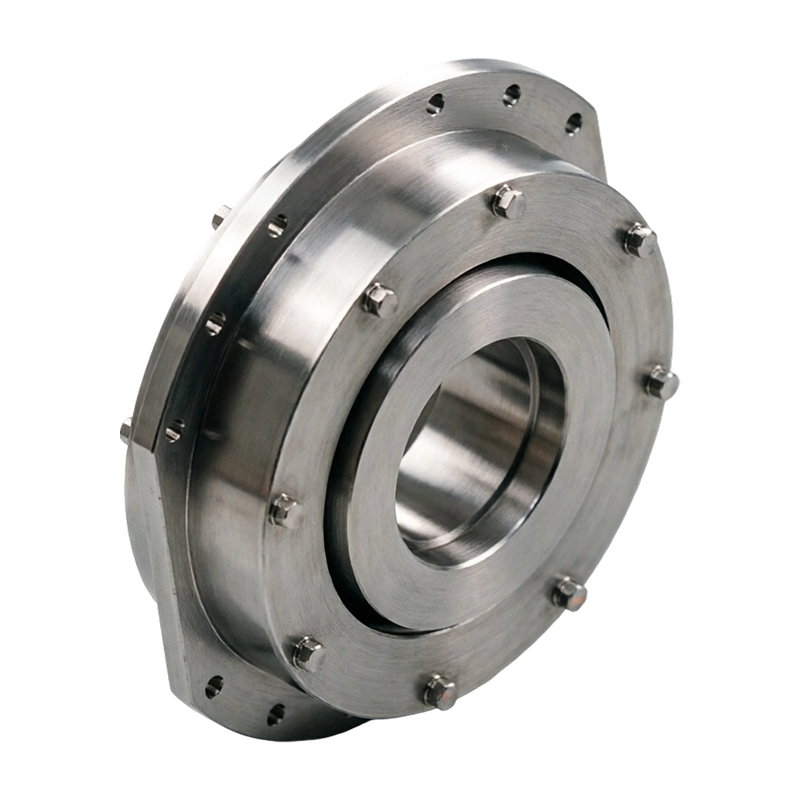
The pressure plates clamp the tyre body between the coupling halves. In many LLA arrangements, the plates are divided into two sections, making installation and replacement more convenient. Their function is not only to hold the tyre in place but also to distribute the fastening load and support torque transmission.
Accurate machining of the pressure plates is important. Uneven surfaces, incorrect bolt-hole positioning, excessive runout, or inconsistent clamping can produce uneven tyre deformation. This may lead to increased vibration, localized wear, and reduced service life. For this reason, the pressure plates require appropriate material selection, machining accuracy, surface inspection, and dimensional verification.
2.3 Coupling Flanges
The coupling flanges connect the tyre assembly to the shafts of the driving and driven machines. They may be configured for different shaft arrangements, bore dimensions, keyways, or installation requirements. The flange design must provide adequate torque capacity while maintaining sufficient strength around the bore, keyway, and bolt connection areas.
The flange geometry also influences the coupling’s ability to accommodate displacement. A well-designed flange supports the tyre without restricting its intended elastic movement. It must also provide enough clearance for installation, inspection, and replacement.
2.4 Fastening Bolts
Fastening bolts secure the pressure plates and maintain the required connection between the tyre and the coupling halves. Bolt grade, diameter, tightening method, and installation sequence all affect coupling reliability. Bolts should be tightened evenly and according to the specified procedure. Uneven tightening may create nonuniform pressure on the tyre, while insufficient tightening may allow movement or loosening during operation.
During maintenance, bolts should be inspected for thread damage, corrosion, deformation, and loss of clamping reliability. Reusing damaged fasteners can compromise the entire coupling assembly, particularly in applications with high impact or reversing loads.
2.5 Optional Protective Cover
A protective cover may be installed where the coupling is exposed to dust, water, oil mist, falling materials, or accidental contact. The cover helps prevent foreign matter from reaching the tyre and can reduce the possibility of external damage to the elastic element.
The cover should be designed with sufficient clearance so that it does not interfere with the tyre during normal deformation. It should also permit suitable inspection and ventilation where required. The need for a cover depends on the machine layout, safety requirements, environmental conditions, and applicable plant procedures.
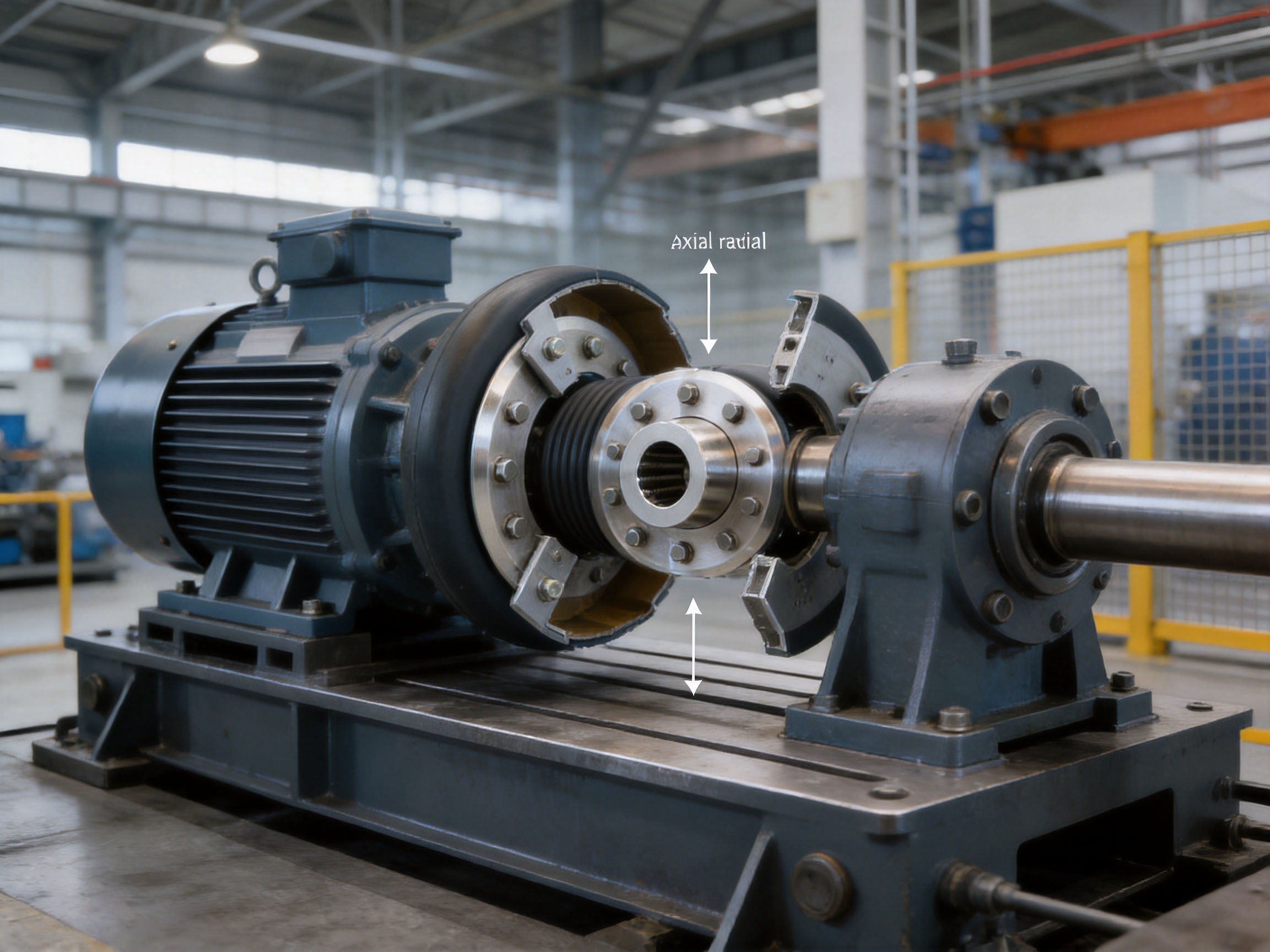
3. Elastic Compensation of Shaft Misalignment
One of the principal advantages of the LLA type tyre coupling is its ability to compensate for several forms of shaft misalignment. In actual equipment, perfect alignment is difficult to maintain. Even when shafts are aligned carefully during installation, operating conditions may introduce movement or deformation.
3.1 Axial Misalignment
Axial misalignment occurs when the connected shafts move toward or away from one another along their centerlines. Such movement may result from thermal expansion, bearing clearance, structural movement, or assembly tolerances. The tyre coupling permits a controlled degree of axial displacement through elastic deformation.
Axial compensation reduces the possibility that the shafts will push against each other or impose excessive thrust on connected bearings. However, the allowable axial movement is not unlimited. The actual permissible value depends on the coupling size, tyre material, operating speed, transmitted torque, and manufacturer’s technical data.
3.2 Radial Misalignment
Radial misalignment occurs when the two shaft centerlines are parallel but offset. It can be caused by incorrect installation, foundation settlement, bearing wear, or movement of a machine casing. The elastic tyre bends and deforms to accommodate this offset, reducing the additional radial force that would otherwise be transmitted through a rigid connection.
Although the coupling can compensate for radial offset, it should not be used to correct poor installation. Excessive offset causes continuous deformation, generates heat, accelerates fatigue, and reduces the service life of the tyre. Initial shaft alignment remains essential for achieving reliable operation.
3.3 Angular Misalignment
Angular misalignment occurs when the two shaft centerlines intersect at an angle rather than remaining collinear. The tyre accommodates this condition through localized bending and elastic distortion. This capability is valuable in machines where connected shafts cannot be perfectly aligned because of structural constraints or operating movement.
Excessive angular misalignment can cause uneven stress distribution in the tyre and pressure plates. It may also produce cyclic variation in the load transmitted through the coupling. For this reason, angular alignment should be checked during installation and periodically reviewed during scheduled maintenance.
3.4 Combined Misalignment
Industrial equipment often experiences combined axial, radial, and angular misalignment rather than one isolated form. The LLA type tyre coupling provides overall displacement compensation, allowing it to respond to combined movement more effectively than a rigid coupling or a coupling with very limited flexibility.
The coupling should nevertheless be selected with an appropriate safety margin. Compensation capability must be considered together with torque, speed, starting frequency, environmental conditions, and the severity of the driven load. Correct selection prevents the elastic element from operating continuously near its maximum deformation.
4. Vibration Absorption and Shock Protection
Vibration is a major source of damage in industrial drive systems. It may originate from motor electromagnetic forces, gear meshing, unbalanced rotating parts, reciprocating mechanisms, structural resonance, or irregular driven loads. If vibration passes directly through a rigid coupling, it can reach bearings, shafts, gear teeth, housings, and foundations.
The elastic tyre acts as a flexible buffer between the driving and driven machines. Its material properties allow it to absorb part of the vibratory energy and reduce the amplitude of vibration transmitted across the shaft connection. This can lower mechanical stress, reduce noise, and improve the operating environment around the equipment.
Shock loads are common in cranes, hoists, conveyors, crushers, mills, and equipment that handles changing material loads. A machine may experience a sudden resistance when a conveyor is loaded, a crane starts lifting, or a drum changes direction. The tyre deforms under the sudden torque increase and releases the energy more gradually than a rigid metal connection would.
By cushioning these events, the coupling helps protect the motor and reducer from severe impact. It can also reduce the risk of damage to shaft keys, gear teeth, bearings, and other transmission components. This does not mean that the coupling can eliminate overload damage under all conditions. Proper torque calculation, safety protection, braking control, and overload management remain necessary.
The damping behavior of the tyre also helps reduce torsional oscillation. In a drive system with a motor, reducer, and variable load, torsional vibration can produce alternating stresses. The flexible coupling changes the dynamic behavior of the system and may reduce the severity of these oscillations when correctly selected and installed.
5. Advantages Compared with More Rigid or Less Maintainable Couplings
5.1 Better Protection than Rigid Couplings
Rigid couplings are effective when shafts are accurately aligned and the system requires a direct mechanical connection. However, they provide little tolerance for alignment errors and do not absorb shock effectively. Any movement or vibration in one shaft is transferred directly to the other shaft.
The LLA type tyre coupling offers a more forgiving connection. Its elastic element compensates for limited misalignment and dampens impact. This makes it more suitable for machines subject to variable loads, frequent starts, reversing operation, and structural movement.
5.2 Convenient Replacement Compared with Enclosed Elastic Couplings
Some flexible couplings require extensive disassembly before their elastic elements can be replaced. In a large industrial installation, this may involve moving a motor, disconnecting a gearbox, removing guards, or disturbing the alignment of the entire drive train.
The open structure of the LLA type coupling provides a practical alternative. After suitable isolation and safety preparation, technicians can loosen the pressure plate bolts and replace the tyre element without dismantling the complete transmission system. This reduces maintenance time and can help restore production more quickly.
5.3 Strong Compensation Compared with Limited-Flexibility Designs
Some compact couplings are designed primarily for torque transmission and provide only limited displacement compensation. They may be suitable for precisely aligned machinery but less effective where movement and vibration are unavoidable.
The LLA type tyre coupling is specifically intended to provide axial, radial, and angular compensation through the deformation of its tyre body. This broad compensation capability gives designers more flexibility when connecting machines with different structural characteristics.
5.4 Improved Load Cushioning Compared with Hard Metallic Connections
Metallic couplings can offer high torsional strength and accurate torque transmission, but many metal designs have limited inherent damping. When a system includes sudden load changes, the absence of damping can increase peak torque and transmit harsh impact through the machinery.
The tyre element provides a cushioning effect that can reduce peak dynamic loading. In applications involving repeated starting, stopping, reversing, or impact, this can contribute to longer service life for the complete transmission system.
5.5 Practical Customization
Different machines require different bore dimensions, shaft arrangements, torque ratings, speeds, environmental protections, and installation clearances. The LLA type platform can be adapted for special requirements through non-standard design and manufacturing.
Customization may include changes to bore size, keyway configuration, flange dimensions, tyre compound, reinforcement, protective cover arrangement, or connection details. Any non-standard design should be confirmed through engineering review to ensure that the final configuration remains suitable for torque, speed, displacement, and environmental conditions.
| Performance requirement | LLA type tyre coupling response | Practical benefit |
|---|---|---|
| Frequent starting and stopping | Elastic tyre absorbs impact energy and reduces peak shock | Lower stress on motors, reducers, shafts, and bearings |
| Variable forward and reverse rotation | Flexible element cushions torque changes in both directions | Improved protection in reversing drives |
| Axial, radial, and angular movement | Tyre deforms to compensate for combined displacement | Reduced additional loads caused by misalignment |
| Dust and moisture exposure | Optional protective cover helps shield the elastic element | Better suitability for challenging industrial environments |
| Planned maintenance | Open tyre structure allows convenient replacement | Reduced downtime and easier servicing |
| Impact and vibration | Rubber or polyurethane tyre provides damping | Lower vibration, noise, and mechanical wear |
| Special shaft or installation requirements | Non-standard designs can be developed when required | Greater compatibility with specialized equipment |
6. Materials and Manufacturing Technology
The reliability of a tyre coupling depends not only on its basic design but also on the quality of the materials and manufacturing processes. The elastic tyre, metal pressure plates, flanges, reinforcement, and fastening components must work together as one mechanical system. Weakness in any component can reduce the performance of the entire assembly.
6.1 Rubber and Polyurethane Formulation
For rubber tyres, compound formulation influences elasticity, tensile strength, abrasion resistance, damping, temperature resistance, and aging behavior. The formulation must be selected according to the intended duty. A coupling exposed to oil mist, outdoor moisture, abrasive dust, or substantial temperature variation may require a different material formulation from one used in a clean indoor environment.
Polyurethane materials can provide high mechanical strength and good resistance to wear. They may be selected where dimensional stability and resistance to repeated deformation are important. The final choice should take account of the complete service environment rather than relying on a general assumption that one material is universally superior.
Material batches should be controlled and traceable. Appropriate incoming inspection may include verification of material identification, hardness, appearance, dimensional consistency, and other relevant properties. Consistent material control helps ensure that tyres produced at different times maintain predictable performance.
6.2 Nylon Reinforcement and Bonding
Where nylon cord or nylon fabric is used, the reinforcement must be positioned accurately within the tyre body. Its orientation, density, and bonding condition affect the tyre’s ability to handle cyclic loading. Poor placement or incomplete bonding can create localized weakness.
The reinforcement is integrated with the elastic material through a vulcanization process. During vulcanization, heat and pressure are controlled so that the rubber compound cures correctly and bonds firmly to the reinforcement and metal connection areas. Process control is essential because insufficient curing, excessive curing, trapped air, contamination, or incorrect temperature can affect mechanical performance.
6.3 Metal Component Production
Metal flanges and pressure plates require suitable material selection, casting or forging procedures where applicable, machining, and finishing. Critical dimensions include bore size, bolt-hole location, flange thickness, contact surfaces, concentricity, and runout.
Computer-controlled or precision machining equipment can be used to maintain consistent dimensions across production batches. Machining procedures should be supported by process inspection so that errors are detected before final assembly. Surface defects, sharp edges, cracks, and unacceptable deformation should be removed or rejected according to internal quality procedures.
6.4 Assembly Control
During assembly, the tyre must be positioned correctly between the coupling halves and pressure plates. Fasteners should be installed in the correct sequence and tightened evenly. The assembly process should prevent contamination of contact surfaces and ensure that the elastic element is not twisted, cut, or locally overstressed.
Final assembly inspection may include visual checks, dimensional verification, runout measurement, bolt inspection, and confirmation of the specified configuration. Where required by the application, dynamic testing or additional performance verification can be arranged.
6.5 Inspection and Testing
A complete quality supervision system should cover raw materials, production processes, semi-finished components, final assembly, and shipment. Testing equipment may be used to assess dimensions, hardness, material properties, balance, runout, and other characteristics relevant to coupling performance.
Quality documentation can include inspection records, material identification, production information, dimensional reports, and shipment verification. Such documentation supports traceability and helps customers manage maintenance and replacement requirements throughout the product life cycle.
7. Engineering Selection Considerations
Correct coupling selection begins with an accurate understanding of the application. A coupling should not be selected solely by shaft diameter. The design must consider torque, speed, duty cycle, load classification, starting conditions, reversing frequency, misalignment, temperature, environment, and available installation space.
7.1 Nominal and Peak Torque
The transmitted torque is one of the most important selection parameters. Engineers should identify the normal operating torque and the highest expected peak torque. Starting torque, braking torque, jam conditions, and impact loads may be significantly higher than the steady operating value.
A suitable service factor should be applied to account for the severity of the driven machine. Conveyors with smooth loading may have different requirements from crushers, hoists, or machines with repeated shock loading. The coupling should have adequate capacity without operating continuously at the limit of its elastic element.
7.2 Rotational Speed
Operating speed affects centrifugal force, heat generation, dynamic balance, and tyre stress. The selected coupling must be appropriate for the intended speed range. If the machine has variable-speed operation, both minimum and maximum speeds should be considered, along with acceleration and deceleration behavior.
At higher speeds, alignment, balance, mounting accuracy, and protective guarding become increasingly important. Any abnormal vibration should be investigated rather than attributed automatically to normal tyre flexibility.
7.3 Starting and Reversing Frequency
Frequent starting and stopping subjects the tyre to repeated cycles of deformation. Frequent forward and reverse operation can create alternating torque stress. Cranes, hoists, indexing systems, and certain material-handling machines may impose particularly demanding duty cycles.
Selection should therefore include the number of starts per hour, the frequency of direction changes, the duration of each operating cycle, and the load carried during acceleration. These factors may influence the appropriate coupling size and tyre material.
7.4 Environmental Conditions
Moisture, dust, chemical vapors, oil, outdoor exposure, and temperature can affect elastic materials and metal components. The tyre compound and protective cover should be selected with the operating environment in mind. If abrasive particles are present, a cover may help reduce external damage. If the coupling is exposed to unusual chemicals or high temperature, material compatibility should be confirmed in advance.
7.5 Shaft and Installation Details
Important mechanical details include shaft diameters, shaft extensions, keyways, hub lengths, available axial space, coupling guard dimensions, and the method used to move or support the connected machine. The coupling must fit the actual installation rather than only the nominal shaft size.
For custom designs, customers should provide accurate drawings or dimensional data. Clear information at the design stage reduces manufacturing revisions and helps ensure that the coupling can be installed and maintained safely.
8. Installation Best Practices
Even a high-quality coupling can fail prematurely if installation is incorrect. The shafts and mounting surfaces should be cleaned and inspected before assembly. Burrs, corrosion, damaged keyways, and foreign material should be removed. Shaft ends should be checked for damage and correct dimensions.
The driving and driven machines should be positioned and aligned according to the installation requirements. Initial alignment should be as accurate as reasonably possible because the coupling’s compensation capability is intended to accommodate operating movement, not to compensate for careless assembly.
The tyre should be inspected before installation. It should not show cuts, cracks, swelling, severe hardening, contamination, or distortion. Pressure plates and flanges should be checked for correct dimensions, bolt-hole alignment, and surface condition.
Fasteners should be tightened gradually in a crosswise or otherwise suitable sequence so that clamping pressure is distributed evenly. The specified tightening method should be followed. After installation, the assembly should be rotated manually where possible to confirm that there is no interference or abnormal resistance.
Protective guards should be installed before the machine is operated. Rotating couplings present serious hazards, and exposed bolts, flanges, or tyre elements should not be approached while the equipment is running. Lockout and isolation procedures must be followed for inspection or maintenance.
9. Maintenance and Replacement of the Tyre Element
Routine inspection is essential for maximizing coupling life. Maintenance personnel should observe the tyre for cracks, cuts, abrasion, swelling, hardening, permanent deformation, and separation from the metal connection areas. Changes in surface appearance may indicate aging, overload, chemical exposure, or excessive heat.
Unusual vibration, noise, temperature, or movement near the coupling should be investigated promptly. These symptoms may be caused by coupling wear, shaft misalignment, loose bolts, bearing problems, imbalance, or a fault elsewhere in the drive system. Replacing the tyre without identifying the root cause may lead to repeated failure.
The open structure of the LLA type coupling simplifies planned replacement. After the machine is stopped, isolated, and made safe, the protective cover is removed if fitted. The pressure plate bolts are loosened and the worn tyre is removed. The mating components are cleaned and inspected before the new tyre is installed.
The replacement tyre must be the correct type and size. Mixing incompatible materials, using an incorrect thickness, or installing a damaged element can affect torque capacity and displacement compensation. The new tyre should be installed without twisting, pinching, or forcing it into position.
After replacement, bolts should be tightened evenly, alignment should be checked, and the guard should be reinstalled. A controlled test run can then be performed while monitoring vibration, noise, temperature, and general operation. Maintenance records should document the replacement date, operating hours if available, observed condition, and any corrective action taken.
10. Applications Across Industrial Sectors
10.1 Transportation and Conveyor Equipment
Conveyors often experience changing loads as materials enter or leave the belt. Starting a loaded conveyor can create substantial torque demand, particularly when the belt is long or inclined. The tyre coupling cushions this starting event and helps protect the motor and reducer.
Conveyor structures may also move slightly because of foundation settlement, temperature changes, or maintenance activity. The coupling’s displacement compensation capability helps maintain reliable operation when small alignment changes occur.
10.2 Metallurgy and Steel Processing
Metallurgical equipment may operate under high loads, elevated temperatures, dust, impact, and frequent cycling. Drives for rollers, processing lines, lifting equipment, and material-handling machinery require strong torque transmission and resistance to dynamic loading.
When correctly selected and protected, the LLA type coupling can reduce shock transmission and help isolate vibration between motors, gearboxes, and driven machinery. Specific temperature and environmental requirements should be reviewed during product selection.
10.3 Mining and Heavy Material Handling
Mining equipment frequently encounters abrasive dust, irregular loads, impact, and difficult maintenance access. Downtime can be costly, and maintenance procedures must often be completed quickly. The replaceable open tyre structure is valuable because it allows the elastic element to be serviced without removing the entire transmission assembly.
A protective cover may be appropriate in areas where falling rock, dust, or slurry could damage the tyre. The coupling should be selected with a suitable service factor for crushers, feeders, conveyors, and other machines with severe duty.
10.4 Construction Machinery
Construction machinery may operate on uneven foundations and experience frequent movement, shock, and changes in load. Equipment such as mixers, winches, hoists, and material-handling systems can benefit from a coupling that combines flexibility with strong load cushioning.
Because construction environments are exposed to dirt and weather, proper guarding and inspection are especially important. The coupling should be protected from unnecessary contamination while remaining accessible for maintenance.
10.5 Cranes and Hoisting Equipment
Cranes and hoists regularly start, stop, reverse, and lift changing loads. These operating conditions produce dynamic torque and require careful control of shock. The tyre coupling helps moderate torque changes between the motor, brake, reducer, and drum drive.
In overload conditions, the coupling halves may provide a protective effect through their snap-jaw arrangement. This feature can help limit the consequences of certain overload events, although it is not a substitute for correctly rated brakes, limit switches, overload protection, and safe operating procedures.
10.6 Paper Machinery
Paper machinery often requires continuous operation, stable speed, controlled vibration, and reliable alignment. Roll drives and auxiliary equipment may be sensitive to vibration and shaft displacement. The tyre coupling can provide elastic isolation while allowing practical maintenance access.
Paper production environments may include moisture, process chemicals, and confined installation areas. Material compatibility, guarding, inspection access, and correct alignment should be considered in the coupling specification.
11. Manufacturing and Service Strengths
The manufacturer of the LLA type tyre coupling is a medium-sized industrial enterprise specializing in couplings and papermaking machinery. Its capabilities integrate product design, production, inspection, and customer service. This integrated structure is valuable because coupling performance depends on coordination between engineering design, material selection, machining, elastic-element production, assembly, and after-sales support.
Strong technical capability supports the development of standard and non-standard coupling solutions. Customers may require different shaft dimensions, installation arrangements, environmental protections, or operating characteristics. An experienced engineering team can review these requirements and develop a practical configuration rather than forcing every application into a single standard design.
Advanced manufacturing equipment contributes to dimensional consistency and production efficiency. Precision machining of flanges and pressure plates helps maintain concentricity, bolt-hole accuracy, and surface quality. Controlled elastic-element production helps provide stable tyre dimensions and predictable mechanical behavior.
Comprehensive testing methods are equally important. Inspection and testing should cover incoming materials, critical production stages, final components, and completed assemblies. This approach helps identify dimensional errors, material inconsistencies, bonding problems, surface defects, and assembly issues before the product reaches the customer.
The company operates under a strict quality supervision system and supplies products to industries including transportation, metallurgy, chemical engineering, mining, construction, and hoisting. Its experience across these sectors provides practical understanding of different operating environments and duty conditions.
Manufacturing according to national standards provides a foundation for consistent product development and inspection. For international projects, technical requirements, customer drawings, application conditions, and delivery specifications should be reviewed during the quotation and engineering stages. Clear technical communication helps ensure that the final product matches the intended use.
Customer support extends beyond production. Pre-sales consultation can help customers define torque, speed, displacement, material, and environmental requirements. Customization services can address non-standard dimensions. Flexible logistics and payment options can support different project arrangements, while maintenance assistance can help users manage replacement and service requirements.
12. Quality Management from Design to Delivery
A reliable coupling is the result of a controlled process rather than a single final inspection. Product quality begins with understanding the application and continues through design review, material purchasing, process control, assembly, testing, packaging, and customer support.
During design review, engineers should confirm torque, speed, shaft dimensions, misalignment, operating temperature, environment, starting frequency, and installation restrictions. Potential overload conditions should be considered before the coupling configuration is finalized.
During material purchasing, suppliers and material batches should be managed carefully. Elastic compounds, reinforcement materials, metals, bolts, and protective components must meet the required specifications. Material identification and traceability help maintain consistency.
During machining, operators should monitor critical dimensions and maintain suitable equipment calibration. Process inspection reduces the risk of producing large quantities of components with the same hidden error. Components that do not meet requirements should be identified and controlled rather than entering final assembly.
During elastic-element production, temperature, pressure, curing time, mold condition, reinforcement position, and bonding quality require attention. These factors influence the strength and durability of the tyre.
During final assembly, the correct components must be matched, and the pressure plate and fastening arrangement must be verified. Inspection records provide evidence that the completed coupling has been checked before shipment.
During packaging and delivery, the tyre should be protected from crushing, sharp objects, excessive heat, oil contamination, and prolonged unsuitable storage conditions. Metal components should be protected against corrosion where necessary. Proper packaging preserves the quality achieved during manufacturing.
13. Storage and Service Life Considerations
Elastic components should be stored in a clean, dry, and reasonably cool location away from direct sunlight, ozone-generating equipment, aggressive chemicals, and sharp edges. Prolonged exposure to ultraviolet radiation, heat, oil, or ozone can accelerate aging of rubber and certain polymer materials.
The tyre should not be stored under unnecessary compression or bending. Heavy objects should not be placed on top of it. If long-term storage is expected, the condition of the elastic element should be inspected before installation.
Service life depends on many variables, including torque, speed, temperature, misalignment, environmental exposure, start frequency, installation quality, and maintenance. A coupling operating under smooth, moderate conditions may last much longer than one exposed to continuous shock and severe misalignment.
Users should establish inspection intervals based on equipment criticality and operating severity. High-duty cranes, mining conveyors, crushers, and reversing drives may require more frequent inspection than smooth-running auxiliary equipment.
14. Safety Considerations
Rotating couplings are hazardous mechanical components. The coupling must be guarded during operation to prevent contact with rotating parts, bolts, pressure plates, and the elastic tyre. Guards should be strong enough to contain or deflect foreseeable contact and should not interfere with coupling movement.
Maintenance must only be performed after the machine has been stopped, isolated, locked out, and verified to be free of stored energy. This includes electrical energy, hydraulic pressure, pneumatic pressure, gravity loads, suspended loads, and residual rotational energy.
Personnel should not attempt to inspect the tyre while the coupling is rotating. Loose clothing, tools, and measuring instruments must be kept away from moving parts. If abnormal vibration or noise is detected, the equipment should be stopped and investigated according to site safety procedures.
The coupling should never be operated above its approved torque or speed rating. It should not be used as a replacement for an overload protection system. Correct system design, proper guarding, routine inspection, and trained maintenance personnel are essential to safe operation.
15. Frequently Asked Questions
Q1: What is an LLA type tyre coupling?
An LLA type tyre coupling is an elastic industrial shaft coupling that uses a rubber or polyurethane tyre to transmit torque while absorbing vibration, cushioning impact, and compensating for axial, radial, and angular shaft misalignment. Its open tyre design allows convenient replacement of the elastic element.
Q2: What are the main components of the coupling?
The main components are the elastic tyre body, metal pressure plates, coupling flanges, and fastening bolts. A protective cover may be added when the coupling operates in dusty, wet, abrasive, or otherwise exposed conditions.
Q3: Why is the open tyre structure useful?
The open structure allows technicians to replace the tyre by loosening the pressure plate bolts instead of dismantling the complete drive system. This can reduce maintenance labor, shorten downtime, and simplify service in large or difficult-to-access installations.
Q4: Can the coupling compensate for all shaft alignment errors?
The coupling can compensate for limited axial, radial, and angular misalignment, including combined displacement. It should not be used to correct poor installation or excessive shaft offset. Initial alignment must still be carried out carefully, and the permitted displacement must remain within the technical limits of the selected coupling.
Q5: Which tyre material should be selected?
Rubber and polyurethane each provide different combinations of elasticity, damping, strength, wear resistance, and environmental compatibility. Selection should consider torque, speed, temperature, chemicals, dust, moisture, starting frequency, and the required service life. Engineering review is recommended for demanding applications.
Q6: Is the coupling suitable for reversing operation?
It is designed for industrial conditions that may include variable forward and reverse rotation. However, the coupling must be correctly sized for reversing torque, acceleration, deceleration, and the frequency of direction changes. These factors should be included in the application data provided for selection.
Q7: Can the coupling be used in crane and hoisting systems?
Yes. Its cushioning and vibration-absorbing characteristics make it suitable for many crane, hoist, and drum-drive applications. The complete system must also include correctly rated brakes, overload protection, guards, limit devices, and appropriate safety controls.
Q8: How can a protective cover improve service performance?
A protective cover can reduce the entry of dust, water, abrasive particles, and other foreign matter. It can also reduce accidental external damage to the tyre. The cover must provide sufficient clearance and should be designed so that it does not restrict normal elastic deformation.
Q9: What signs indicate that the tyre should be replaced?
Replacement may be required when the tyre shows cracks, cuts, severe abrasion, swelling, hardening, permanent deformation, separation, or other signs of aging. Unusual vibration, noise, temperature, or coupling movement may also indicate tyre deterioration or another drive-system problem.
Q10: Can non-standard couplings be produced?
Non-standard couplings can be customized for special shaft dimensions, bore arrangements, keyways, installation clearances, protective covers, materials, or operating requirements. Customers should provide accurate technical information so that the design can be reviewed before production.
Q11: What information is needed for coupling selection?
Useful information includes motor power, operating torque, starting torque, rotational speed, shaft diameters, shaft extensions, keyway details, direction of rotation, start and stop frequency, reversing frequency, expected misalignment, ambient temperature, environmental exposure, installation space, and driven-machine type.
Q12: How does the coupling protect connected equipment?
The elastic tyre absorbs part of the shock and vibratory energy generated during operation. This reduces the direct transmission of impact to motors, reducers, shafts, bearings, and other components. It also reduces additional forces caused by limited misalignment, helping improve the overall operating condition of the transmission system.
16. Conclusion
The LLA type tyre coupling is a practical solution for industrial power transmission systems that require flexibility, shock absorption, displacement compensation, and convenient maintenance. Its high-strength rubber or polyurethane tyre provides elastic damping, while optional nylon reinforcement can improve load-bearing performance and durability. Metal pressure plates, flanges, and fastening bolts create a robust connection capable of transmitting torque under demanding operating conditions.
Its most distinctive practical advantage is the open tyre design. The elastic element can be replaced without dismantling the entire transmission system, which is especially valuable for cranes, conveyors, mining equipment, metallurgy machinery, construction machinery, and other installations where downtime is costly.
Compared with rigid couplings, the LLA design offers better protection against vibration, impact, and shaft displacement. Compared with less accessible enclosed flexible couplings, it provides a simpler maintenance procedure. Its ability to compensate for axial, radial, and angular misalignment makes it suitable for equipment affected by thermal expansion, foundation movement, structural deformation, and variable operating loads.
Reliable performance depends on correct selection, accurate alignment, proper installation, suitable guarding, and regular inspection. The manufacturer’s integrated capabilities in design, production, testing, customization, and customer service support the development of coupling solutions for a broad range of industrial applications. With controlled manufacturing processes, comprehensive quality supervision, and application-oriented engineering support, the LLA type tyre coupling can contribute to safer, smoother, and more durable industrial transmission systems.
References
1. Industrial Flexible Coupling Engineering Principles, technical reference material on torque transmission, vibration damping, and shaft misalignment.
2. Rubber and Polyurethane Elastomer Selection Guide, reference material on elastic materials, environmental resistance, and mechanical performance.
3. Mechanical Power Transmission Design Practice, engineering guidance on coupling selection, service factors, starting loads, and operating speed.
4. Industrial Machinery Alignment and Maintenance Manual, reference material on shaft alignment, coupling installation, inspection, and replacement.
5. Elastomeric Component Manufacturing and Vulcanization Technology, technical reference on reinforcement, bonding, curing control, and quality inspection.
6. Industrial Rotating Equipment Safety Practices, guidance on guarding, lockout procedures, stored energy, and maintenance safety.
7. Manufacturer-provided product information for LLA type tyre couplings, including construction, application characteristics, customization, and service considerations.
Product: LLA Type Tyre Coupling
PREV: DC Type Crowned-Gear Drum Coupling for Heavy-Duty Hoisting SystemsNEXT: WGC Type Vertical Crowned-Gear Coupling: Reliable Power Transmission for Vertical Drive Systems
Be the First to Know
For exclusive deals and latest offers, sign up by entering your email address below.
News
-
-
Industrial Couplings: The Definitive Technical Encyclopedia – Classification, Sizing, Failure Prevention, and Lifecycle...
READ MORE -
Your compressor train is running at 9,800 rpm when the vibration monitor triggers an alarm. The first component your ma...
READ MORE -
Two quotes land for the same replacement gear coupling: $1,850 from one shop and $2,600 from another. Both promise stan...
READ MORE -
A coupling fails at 2:10 a.m. on a continuous production line. The drive train stops, alarms sound, and every idle minu...
READ MORE -
China's coupling industry is at a critical historical juncture of transformation from scale expansion to quality and eff...
READ MORE


ABOUT US
PRODUCTS
INDUSTRIES
CONTACT US
- Phone: +86-18652865511
- Email: sales@ohmach.com
- Address: No.1, Minying Developing Zone, Zhenjiang, Jiangsu, China
Copyright Zhenjiang Orienthold Machinery Co., Ltd. All Rights Reserved.
 Custom Industrial Shaft Coupling Manufacturers